

A $100 million exit is a design problem, not a payday. This piece lays out how to divide sale proceeds into Income, Legacy, and Growth buckets, and why coordinating a wealth advisor, CPA, and estate attorney before the letter of intent matters more than any single tool.
Most founders treat the sale price as the finish line. It is the starting line for a second, harder problem: turning one concentrated, taxable event into a plan that funds a lifetime, protects a family, and keeps compounding.
In our last piece, we looked at the structured installment sale as a way to time the tax bill on a business exit.* A single tool, however, does not make a plan. One approach is to divide the proceeds by purpose, assign each dollar a job, and coordinate every piece before signing the letter of intent.
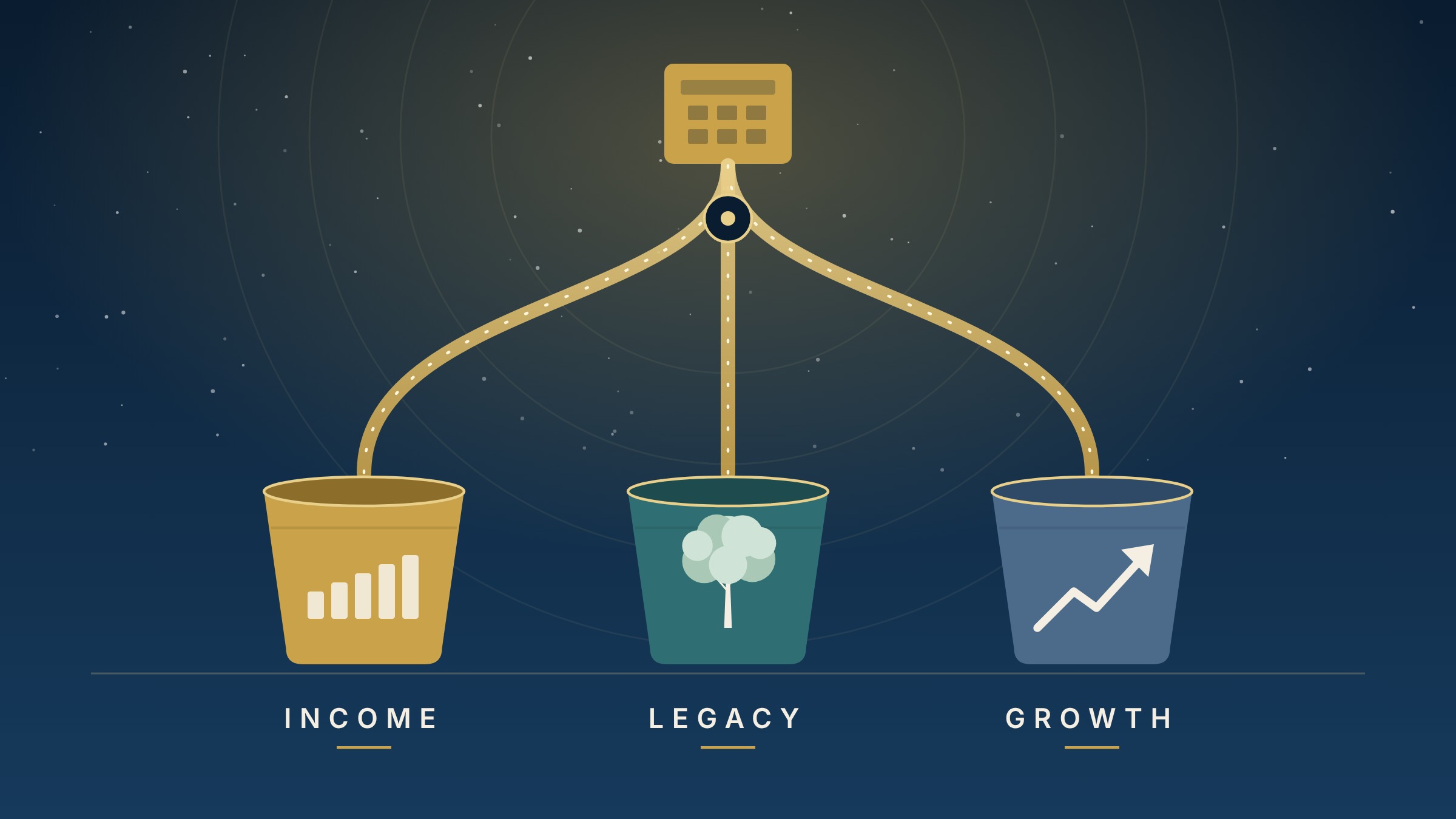
We call this the three-bucket exit: Income, Legacy, and Growth.
A $100 Million Hypothetical
Consider a married founder selling a company for $100 million.** Rather than taking the proceeds as one lump sum and deciding what to do afterward, the family allocates the value across three buckets, each with a distinct job.
• Income — $30M. Job: predictable cash flow. Primary vehicles: a structured installment sale with a 25-year payout.
• Legacy — $30M. Job: move wealth and future growth outside the taxable estate. Primary vehicles: pre-sale gifts of company shares to irrevocable trusts, and an ILIT with survivorship life insurance.
• Growth — $40M. Job: flexibility, opportunity, and tax management. Primary vehicles: revocable living trust portfolios.
The percentages are illustrative. The discipline is the point: every dollar is assigned a purpose before closing, and each bucket is designed to support the other two.
Bucket 1: Income ($30M Structured Installment Sale)

The first bucket is designed to provide a stable income foundation. The founder directs $30 million of the purchase price into a structured installment sale, with payments scheduled over 25 years. A qualified assignment company purchases an annuity to fund the stream, and capital gain is generally recognized pro rata as each payment arrives rather than all in the year of sale. In an asset sale, depreciation recapture is taxed in the year of sale regardless of when payments are received.
The result is a baseline of contractual income that does not depend on markets, a portfolio manager, or the next deal. That baseline changes behavior. A founder whose core lifestyle expenses are covered can let the Growth bucket take long-term risk without being forced to sell in a downturn.
Carrier Selection
The payment stream is backed by the issuing insurance company's claims-paying ability. That makes carrier selection a central part of the advice, not an afterthought. We help clients narrow the field to carriers rated A or better by the major independent rating agencies, with an established history of issuing structured settlement and structured sale annuities. We review financial strength, the qualified assignment arrangement, and concentration with any single carrier before a placement is recommended, and we continue to monitor the carrier after closing.
Stretching Beyond the $5 Million Threshold
Section 453A imposes an annual interest charge on deferred tax when installment obligations that arise in a tax year and remain outstanding at year-end exceed $5 million. The charge applies only to the share of deferred tax tied to the excess. At $30 million, the threshold is a design constraint, and there are established ways to expand it:
• Multiple owners, multiple thresholds. The $5 million test is applied taxpayer by taxpayer. When shares are held by co-founders, family members, or separately taxed entities, each owner measures the threshold on their own obligations, which expands the total that can be deferred without the charge. Spouses who file jointly should confirm with their CPA how the threshold applies to them.
• Separately taxed trusts. Shares gifted before the sale to properly structured non-grantor trusts can give each trust its own threshold. This must be weighed against the benefits of grantor trust status in Bucket 2, and against the multiple-trust rules, which can combine trusts created mainly to avoid tax.
• Pass-through ownership. For businesses held in partnerships or S corporations, the test is generally applied at the partner or shareholder level, so each owner's share is measured separately.
• Staged closings across tax years. Because the test looks at obligations arising in each tax year, a sale that closes in tranches across two tax years can create a second threshold, where the buyer and deal terms support it.
• Model the excess. Above the threshold, deferral can still come out ahead once the interest charge is weighed against bracket management, the value of spreading the gain, and the annuity's terms. The answer is specific to each case and belongs in the CPA's projections.
Other Tradeoffs
• Inflation. A level payment loses purchasing power over 25 years. The schedule can be built with increasing payments, and the Growth bucket provides a hedge.
• No acceleration. The stream generally cannot be sold, pledged, or accelerated. Liquidity for anything unplanned must come from the Growth bucket.
• Buyer cooperation. The structure must be negotiated into the purchase agreement. It is far easier to secure before the letter of intent than during due diligence.
Bucket 2: Legacy ($30M to Irrevocable Trusts and an ILIT)

The second bucket answers a question most founders postpone: how much of this wealth reaches the next generation after estate tax. For 2026, the federal estate and gift tax exemption is $15 million per person, or $30 million for a married couple, with a top rate of 40% above that.
Timing inside this bucket matters more than the dollar amount. Gifting $30 million of cash after closing uses the full exemption dollar for dollar. Gifting company shares to irrevocable trusts well before a buyer appears may, depending on the circumstances and a properly supported valuation, permit interests to be transferred at a value reflecting applicable valuation discounts, with subsequent appreciation potentially occurring outside the taxable estate. When those trusts are structured as grantor trusts, the founder pays the income tax on trust earnings, which lets the trust compound for the family while further reducing the taxable estate.
Strategic Estate and Inheritance Liquidity Planning
Even after these transfers, the family could still hold a taxable estate of tens of millions of dollars between the Income and Growth buckets, before any growth. Estate tax is generally due nine months after death, and a plan that leaves heirs to raise that cash by selling assets under pressure has failed at the last step.
An irrevocable life insurance trust (ILIT), funded with survivorship coverage sized to the projected estate tax, may provide one strategy for addressing this liquidity need. When properly structured and administered, the proceeds generally arrive outside the taxable estate, providing liquidity that may be available when estate taxes become due, so heirs may be better positioned to keep the portfolio, the trusts, and any family enterprise intact.
The Income bucket makes this planning more important. Installment payments still owed at death are included in the estate and are also taxed as income to the heirs as they are received, subject to a partial income tax deduction for the estate tax attributable to those payments. Sizing the ILIT with that exposure in mind turns a potential forced sale into a funded, planned event.
Bucket 3: Growth ($40M in Living Trust Portfolios)

The third bucket is where the founder keeps control. Held in revocable living trusts for privacy and probate avoidance, these assets fund opportunity, handle the unexpected, and do the heavy lifting on tax management. A representative mix includes three sleeves:
• Tax-aware long/short equity. These strategies are designed to generate realized capital losses while seeking to track a market benchmark. They typically use leverage and short sales, which can magnify losses, and generally carry higher costs than long-only strategies. Harvested losses also reduce the portfolio's cost basis, which can increase gains when positions are later sold. Funded at or before closing, realized losses, when available and subject to applicable tax rules and the investor's circumstances, may be used to offset eligible capital gains, including potential gains associated with the sale or subsequent installment payments, which links Bucket 3 directly to Bucket 1.
• Fixed income. High-quality bonds provide a reserve for planned liquidity needs, and capital that can be redeployed when other assets are attractively priced.
• Opportunity capital. Many founders are not done building. A defined, liquid reserve lets them deploy capital at will into new ventures, which may include private equity or direct investments when the right opportunity appears, without disrupting the rest of the plan.
Liquidity is what makes the whole structure work. The Income bucket cannot be accelerated, and the Legacy bucket is irrevocable, so this is the only place the family can reach for flexibility.
Coordination Is the Strategy
Each bucket on its own is a known technique. The value comes from how they interact, and those interactions cross professional lines. Losses harvested in Bucket 3 are only useful if the CPA times them against gain from Bucket 1. Trusts in Bucket 2 are only effective if the attorney drafts them and completes the transfers before valuations rise. The ILIT is only right-sized if someone is projecting the estate that Buckets 1 and 3 will leave behind.
That is why the three-bucket exit requires a team working from one roadmap:
• Wealth advisor — Owns the overall plan, bucket sizing, portfolio design, and carrier and insurance analysis. Coordination matters most in matching loss harvesting to gain recognition and stress-testing cash flow across all three buckets.
• CPA — Owns tax projections, entity and deal structure, and Section 453A modeling. Coordination matters most in sale-year and multi-year tax modeling, threshold planning, and grantor trust reporting.
• Estate planning attorney — Owns trust and ILIT drafting, gifting strategy, and valuations. Coordination matters most in completing transfers before value is locked in by a buyer.
At Imperio Wealth Advisors, we coordinate that team. Our role is to keep the CPA, the attorney, and the family working from the same numbers and the same calendar, so each decision is made with the other two buckets in view. When three capable advisors each optimize their own piece in isolation, important planning considerations can be missed where the pieces intersect.
The Takeaway
A liquidity event rewards the founders who plan for it as carefully as they built the business. Income, Legacy, and Growth are one plan, and the most valuable moves inside it, from pre-sale gifting to negotiating the installment structure, may become more limited once a letter of intent is signed or a transaction becomes sufficiently certain.
If you are considering an exit in the next few years, now is the time to bring your wealth advisor, CPA, and estate attorney to the same table. We would welcome the conversation.
* Refers to our prior article, “Structured Installment Sales: A Smarter Way to Time the Tax Bill on Your Business Exit.”
** The $100 million business sale and the allocations described are hypothetical and illustrative only. They do not represent an actual client, transaction, portfolio, or recommendation. The amounts, allocations, structures, and time periods shown were selected solely to illustrate the concepts discussed and should not be interpreted as appropriate for any particular investor or transaction.
This material is provided for informational and educational purposes only and is intended to illustrate certain financial, investment, tax, estate planning, and insurance concepts that may be considered in connection with the sale of a business. It is not intended to provide, and should not be relied upon as, individualized investment, tax, legal, estate planning, insurance, or other professional advice or as a recommendation to implement any particular strategy, transaction, structure, investment, or allocation. The strategies discussed involve significant risks, costs, limitations, eligibility requirements, and tax and legal considerations. Structured installment sales may involve illiquidity, restrictions on acceleration or transfer, insurer and counterparty credit risk, and tax consequences, including potential interest charges under Section 453A. Annuity and life insurance guarantees are subject to the claims-paying ability of the issuing insurance company. Carrier ratings are opinions of the applicable rating agencies, are subject to change, and do not guarantee future financial strength or the payment of benefits. If an annuity or life insurance policy is placed through an Imperio representative acting as a licensed insurance agent, that representative may receive commissions, which creates a conflict of interest. Trust, gifting, valuation, and estate-planning strategies depend on individual circumstances, proper structuring and administration, applicable law, and the timing of a transaction. Valuation discounts, estate-tax treatment, exclusion of assets or insurance proceeds from a taxable estate, and other tax or estate-planning outcomes are not guaranteed. Tax-aware investment strategies may seek to generate capital losses, but there is no assurance that losses will be generated when needed or in amounts sufficient to offset gains. The availability and use of losses depend on market conditions, portfolio activity, the character and timing of gains and losses, and applicable tax rules. Investment strategies, including long/short strategies, fixed income, private equity, and direct investments, involve risk, including the possible loss of principal. Diversification and tax-management strategies do not ensure a profit, eliminate taxes, or protect against investment losses. Tax laws, estate and gift tax exemptions, Section 453A requirements, and other legal and regulatory provisions are subject to change and interpretation. Imperio Wealth Advisors does not provide tax or legal advice. Business owners should consult qualified tax, legal, estate planning, insurance, and financial professionals regarding their individual circumstances before implementing any strategy discussed.